Oslo Public Library
- Nigel Wakeham
- Sep 11
- 4 min read


During our visit to Scandinavia, we spent a weekend in Oslo, going by train from Gothenburg.
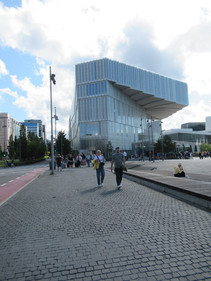
The city has a number of ‘iconic’ buildings including the Opera House and the Munch Museum but in my opinion, the most interesting is the new public library in Bjørvika on the waterfront close to the Opera House. The building, called Deichman after the founder of the Norwegian library system, was the result of an international architectural competition that was won in 2009 by local architectural firms, Lundhagen Arkitekter and Atelier Oslo. It opened in June 2020.
The librarians wanted a building that would inspire visitors to explore all of the new facilities and activities that a modern library can offer. The site is relatively small, limited by the surrounding roads and a sightline to the neighbouring Opera House that had to be preserved. The building therefore cantilevers at upper levels on two sides: on the east side, the first floor cantilevers out over the ground floor providing a covered route along the street and on the opposite side the fourth floor cantilevers out almost 20 metres above the plaza below providing a large, internal space and giving some protection to the entrance below but still preserving the line of site to the neighbouring Opera House. This cantilever is suspended from the folded, reinforced concrete roof.
The cantilevers have another function in that, because the site is quite small, without the cantilevers the building would have to have been at least another storey higher, something that the designers wished to avoid. The building is therefore organised on five floors, four above ground level: the basement contains a cinema and a 200-seat auditorium; the ground floor has a large open public space, lit from all sides, for exhibitions, reading and sitting around plus a café and a separate restaurant; the first floor contains fiction and children’s books; the second and third floors contain more books and enclosed areas including recording studios and mini-cinema and gaming rooms and on the fourth floor there are social science books and reading rooms as well as the spectacular cantilever which has a stepped floor and wonderful views of the fjord below. The spaces become quieter and more contemplative as you move up the building.
There are entrances on three of the facades and diagonal light shafts cut diagonally through the building from each of the entrances providing views of the upper floors and distributing light to all floors from three large rooflights. Physical connections between the floors are provided by escalators, lifts and stairs.
All facades are glazed and in order to enhance the connection to the city, the ground floor façade is completely transparent. The insulated, glazed facades to the upper floors provide even lighting and are protected from the sun by external, transparent or semi-transparent screens. Large windows in the corners of all floors provide panoramic views of the city. At night the whole building is lit up by the interior lighting.
It is a truly delightful, well-designed building that is obviously well liked by Oslo residents and visitors. On the day that we visited it was very busy on the ground floor with people looking at exhibits, reading newspapers and journals, sitting around talking to friends, visiting the café, taking shortcuts across the building, etc. There was also a playgroup. The upper floors were quieter and less crowded but were also being well used. It shows that even in these days of search engines and smart phones, a lot of people still want to read books and to use the other facilities that such a public building can provide. A lesson to be learned by central and local governments in UK.
Gallery







Architecture in Developing Countries: A Resource
The design and construction of appropriate, low-cost buildings for education and health in rural areas of the developing world.
Nigel Wakeham is an architect who lived for 23 years in Southern and West Africa and the SW Pacific working on education, health and other projects. He has since worked for over 20 years as a consultant for national governments and agencies such as the World Bank, DFID, ADB and AfDB on the implementation of the construction components of education and health projects in many countries in the developing world.
The objective of this website will be to provide the benefit of more than 45 years of experience of working in developing countries to architects and other construction professionals involved in the design and construction of appropriate, low-cost buildings for education and health. It will provide reference material from the projects that Nigel has worked on and technical information on the design, construction and maintenance of educational and health facilities and other relevant topics and these will be added to from time to time.
I am happy to be contacted by anyone requiring further information on any of the projects or resources referred to in this website or by anyone wishing to discuss work possibilities.


Comments